
Tag: Theory

Only One Man Can Save Venice: Mickey Mouse
In 2008, the Instituto Veneto awarded me a prize for this essay on the future of Venice, which advocated charging tourists €50...
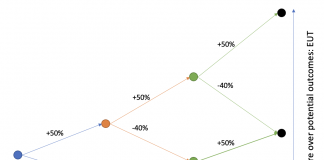
Psychology is Fundamental: The Limitations of Growth-Optimal Approaches to Decision-Making Under...
I have a new working paper with Matthew Ford looking at 'Ergodicity Economics', which is an attempt to produce "a re-write of...
Economic Ideas You Should Forget: The Axioms of Revealed Preference
John's contribution to this book, published by Springer in March 2017.
The fallacy of helicopter money
The term “helicopter money” is derived from a vivid image created by the US economist Milton Friedman in which a central banker showers notes on a grateful populace. More recently, the notion has been promoted by Adair Turner, the former chairman of the UK financial regulator, in his book, Between Debt and the Devil .
Beware “mathiness”: The use of algebra and data to reinforce ideological...
It is characteristic of science to give precise meaning to concepts and the basis of their measurement. Economics is genuinely harder. Yet it is all too easy to write a mathematical symbol without giving thought to what observable fact in the real world corresponds to that symbol.
Take care with summary statistics when the underlying population is changing
Since 2008, UK employment has risen substantially and working hours have increased but output has barely grown. To explain this productivity puzzle we must dig into the detail of how aggregate statistics are built up.
We can reform the economics curriculum without creating new disciplines
Following the global financial crisis there has been much discussion of curriculum reform in university economics teaching. More pluralism is required, but there is no need for "two communities within the same discipline".
Why worry about deflation?
Our perception that inflation is the normal condition is no more than a reflection of the experience of people alive today. And there is no qualitative difference between an economy in which prices are rising slightly and one in which prices are falling slightly.
If “capital is back” it’s in a different sense
The days when economic power was acquired by inheriting the mill are long gone. Mr Buffett began his business career as a mill owner, but closed the mills and went into insurance. That is the reality of capital in modern economics.
Precise inflation figures ignore evolutions in product quality and consumer choice
Price indices are compiled by measuring the changes in the cost of buying a fixed bundle of goods chosen to represent the consumption of an average household. But what the average household buys changes with the arrival of new goods; and with changes in relative prices; as well as with variations – good and bad – in quality